Pakistan: Land of the Pure
The name "Pakistan" is the Urdu and Persian translation for "Land of the Pure" and refers to the many Muslims who live in the country.
Overview
| Flag |
|
| Anthem |
قومی ترانہ (Qaumī Tarāna)
Watch on youtube (with lyrics)
|
| Capital |
Islamabad |
| Largest city |
Karachi |
| Official language(s) |
Urdu / English |
Demonyma name for a resident of a locality, often the same as the name of the people's native language
|
Pakistani |
| Government |
Federal Parliamentary republic |
| Area |
803,940 km2, 340,403 sq mi |
| Population |
~ 170 million |
| Currency |
Pakistani Rupee (Rs.) (PKR) |
| Internet TLD |
.pk |
Geography
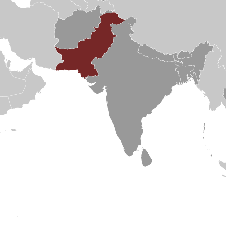
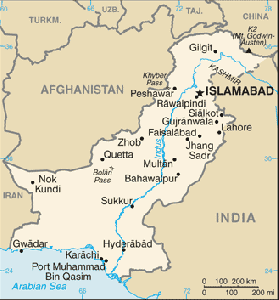
Pakistan, officially the Islamic Republic of Pakistan, is a country in South Asia. It has a 1,046-kilometre (650 mi) coastline along the Arabian Sea and the Gulf of Oman in the south. It is bordered by Afghanistan and Iran in the west, India in the east and China in the far northeast.
The capital city of Pakistan is Islamabad. With a population of 1.21 million, the city is only the tenth largest city in the country. The largest city is Karachi with a population of more than 13 million people. Other large cities are Lahore and Faisalabad.
Society and culture
Pakistani society is largely
hierarchicalranked so that every one but the topmost is subordinate to a specified one above it, with high regard for traditional Islamic
valuesattitudes and principles of right and wrong in behaviour. The culture of Pakistan comprises numerous diverse cultures and ethnic groups. In
ancientoccurring in time long past, usually in remote ages times, Pakistan was a major cultural
huba point where many routes meet and traffic is distributed. One of the greatest cultural influences was that of the Persian Empire.
Population
The estimated population of Pakistan in 2010 was over 170 million. This number makes Pakistan the world's sixth most-
populoushaving more people, as a relative comparison of regions country. The major ethnic groups of Pakistan in numerical size include: Punjabis, Pashtuns, Sindhis, Seraikis, Muhajirs, Balochis, Hindkowans, Chitralis and other smaller groups. Pakistan's
censusan official count of members of a population does not include the registered 1.7 million Afghan
refugeesa person seeking a state of safety, protection or shelter in a foreign country out of fear of political persecution or due to poverty from neighbouring Afghanistan.
Languages
Pakistan is a
multilingualpertaining to more than two languages country with more than sixty languages being spoken. English is the official language of Pakistan. It is used in official business, government, and legal
contractsan agreement between two or more parties. Urdu, however, is the national language. Some
provincialpertaining to a territorial area within a country languages are Punjabi, Saraiki, Pashto, Sindhi and Balochi.
Religion
Islam is the state religion in Pakistan, which is practised by about 95-97% of the population. The remaining 3-5% practise Christianity, Hinduism and other religions.
Government and politics
Pakistan is a democratic parliamentary federal republic. The Constitution of 1973 is the country's most important document, laying the foundations of the current government. The
bicameralhaving two chambers of government legislaturethe part of government which has the power to make laws comprises a 100-member Senate and a 342-member National Assembly. The president is the Head of state and the Commander-in-chief of the
Armed Forcesthe military forces of a nation, such as the army, navy, air force and marines. Pakistan's current president is Asif Ali Zardari.
Economy
Today, Pakistan is regarded as having the second largest economy in South Asia. The structure of the Pakistani economy has changed from a mainly agricultural base to a strong service base. Agriculture now only
accounts forto constitute in amount or portion 20% of the
GDPgross domestic product; a measure of the economic production of a particular territory in financial capital terms over a specific time period, while the service sector accounts for 53% of the GDP. Important industries include
apparelclothing and textiles, food processing, chemicals manufacture, and the iron and steel industries.