Papua New Guinea
Overview
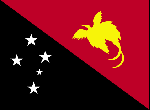
| Flag |
|
| Anthem |
O Arise, All You Sons
Watch on youtube
|
| Capital |
Port Moresby |
| Largest city |
Port Moresby |
| Official language(s) |
English / Tok Pisin / Hiri Motu |
Demonyma name for a resident of a locality, often the same as the name of the people's native language
|
Papua New Guinean |
| Government |
Federal Constitutional Monarchy and Parliamentary Democracy |
| Area |
462,840 km2, 178,703 sq mi |
| Population |
~ 7 million |
| Currency |
Papua New Guinean kina (PGK) |
| Internet TLD |
.pg |
Geography
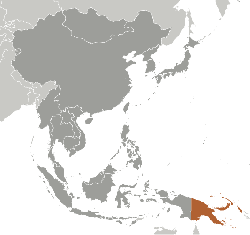
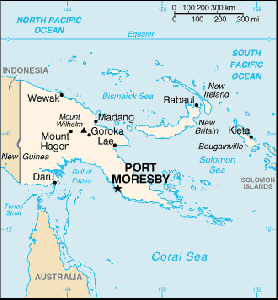
Papua New Guinea is a country in Oceania. It occupies the eastern half of the island of New Guinea and numerous
offshorelocated in the sea away from the coast islands. It is located in the southwestern Pacific Ocean, north of Australia.
The capital of the country is Port Moresby. The city is the largest city of Papua New Guinea and has an estimated population of 307,643.
Society and culture
Papua New Guinea is one of the most
diverseconsisting of many different elements countries on Earth. There are over 850
indigenousnative to a land or region, especially before an intrusion languages in the country. There are almost as many traditional societies in the population of just under 7 million.
Population
There are hundreds of ethnic groups indigenous to Papua New Guinea. The majority is from the group known as Papuans. Many
remotedistant or otherwise disconnected from others Papuan
tribessocially, ethnically, and politically cohesive groups of people still have only little contact with the outside world. Another ethnic group is the group of Austronesians. There are also numerous people from other parts of the world in the country, including Chinese, Europeans, Australians, Filipinos, Polynesians and Micronesians.
Languages
Papua New Guinea has more languages than any other country. Over 820 indigenous languages in the country represent twelve percent of the world's total. The indigenous languages are classified into two large groups: Austronesian languages and non-Austronesian (or Papuan) languages. There are three official languages in Papua New Guinea. English is an official language and is the language of government and the education system. However, it is not widely spoken. The primary
lingua francaa common language used by people of diverse backgrounds to communicate with one another of the country is Tok Pisin (commonly known in English as New Guinea Pidgin). The only area where Tok Pisin is not dominant is the southern region of Papua. In this region, people often use the third official language, Hiri Motu.
Religion
The 2000 census found that 96% of citizens identified themselves as members of a Christian church. However, many citizens combine their Christian faith with some pre-Christian traditional indigenous religious
practicescustomary actions and behavior. Minority religions include the Bahá'í Faith (15,000 people) and Islam (more than 4000 people).
Government and politics
Papua New Guinea's head of state is Queen Elizabeth II. She is also the head of state of 15 other countries and of the Commonwealth of Nations, of which Papua New Guinea is a member. The Queen is represented by the Governor-General of Papua New Guinea, currently Sir Paulias Matane. Actual
executiveresponsible for enforcing laws and judicial decisions, and for the day-to-day running of the state power lies with the Prime Minister who heads the
cabinetthe group of ministers responsible for creating government policy and for overseeing the departments comprising the executive branch. The current Prime Minister is Sir Michael Somare.
Economy
Papua New Guinea is richly
endowedto be furnished with something naturally with natural resources. Agriculture provides a
livelihooda person's means of supporting himself for 85% of the population. Mineral deposits, including oil,
coppera reddish-brown, metallic element, and gold, account for 72% of export earnings. The country also has a notable coffee industry. Other
cropsplants grown for food include cocoa, oil palm and tea. Still, many people live in extreme
povertythe state of having little or no money. About one third of the population lives on less than US$1.25 per day.