Tanzania
Overview
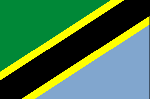
| Flag |
|
| Anthem |
Mungu ibariki Afrika (God Bless Africa) |
| Capital |
Dodoma |
| Largest city |
Dar es Salaam |
| Official language(s) |
Swahili (de facto) / English (Higher courts, higher education) |
Demonyma name for a resident of a locality, often the same as the name of the people's native language
|
Tanzanian |
| Government |
Republic |
| Area |
945,203 km2, 364,898 sq mi |
| Population |
~ 44 million |
| Currency |
Tanzanian shilling (TZS) |
| Internet TLD |
.tz |
Geography
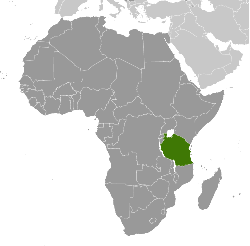
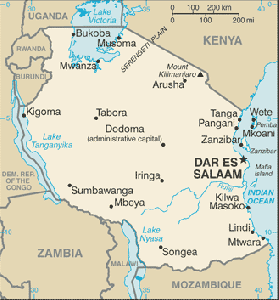
Tanzania is a country in central East Africa. It is bordered by Kenya and Uganda to the north, Rwanda, Burundi and the Democratic Republic of the Congo to the west, and Zambia, Malawi and Mozambique to the south. The country's eastern borders lie on the Indian Ocean.
Since 1996, the official capital of Tanzania has been Dodoma, where parliament and some government offices are located. Before that, the major
coastalon or near the coast city of Dar es Salaam served as the country's political capital. Today, Dar es Salaam remains the principal
commercialpertaining to the exchange or buying and selling of commodities city of Tanzania. It is the major seaport for the country and its
landlockeda term used to refer to a region, especially a country, that does not border the sea neighbours.
Society and culture
Population
As of 2009, the estimated population was 43,739,000. More than 80 percent of the population is
ruralliving in less-populated, non-urban areas. The population consists of more than 120 ethnic groups: the Sukuma and Nyamwezi, the Hehe and Bena, the Gogo, the Haya, the Makonde, the Chagga and the Nyakyusa have more than 1 million members. Other groups include the Pare, Shambaa (or Shambala), and Ngoni. The population also includes people of Arab, Indian, and Pakistani origin, and small European and Chinese communities.
Languages
Tanzanian law no longer constitutes English as the official language. However, it can still be considered as an official language because it is still the language of higher courts. Tanzanians therefore see themselves as having two official languages: English and Swahili. Swahili is the
unifyingpromoting unity language of the country between different
tribesa socially, ethnically, and politically cohesive group of people who each have their own tribal language. English provides Tanzanians with the ability to participate in the global economy and culture.
Religion
The religious balance is seen as a sensitive topic in Tanzania. The population has been estimated to consist of Christians (30%), Muslims (30%) and followers of
indigenousnative to an area religious groups (30%). There are a few communities of other religious groups, such as Buddhists, Hindus, and Baha'is.
Government and politics
The United Republic of Tanzania is a unitary republic. It is a state in which one party is dominant: the Chama Cha Mapinduzi. The current head of state is President Jakaya Mrisho Kikwete, elected in 2005. The president selects his cabinet from among National Assembly members. Tanzania has a five-level
judiciarythe court system and judges considered collectively combining the
jurisdictionsthe limits within which authority may be exercised of tribal, Islamic, and British common law.
Economy
The economy is mostly based on agriculture. Agriculture provides around 85% of exports, and employs approximately 80% of the
workforceall the workers employed by a nation.
Topographythe surface features of a place and climate, though, limit cultivated crops to only 4% of the land area. The nation has many resources including gold and natural gas. Industry is mainly limited to processing agricultural products and light consumer goods.