Zambia
Overview
| Flag |
|
| Anthem |
Stand and Sing of Zambia, Proud and Free |
| Capital |
Lusaka |
| Largest city |
Lusaka |
| Official language(s) |
English |
Demonyma name for a resident of a locality, often the same as the name of the people's native language
|
Zambian |
| Government |
Republic |
| Area |
752,618 km2, 290,587 sq mi |
| Population |
~ 13 million |
| Currency |
Zambian kwacha (ZMK) |
| Internet TLD |
.zm |
Geography
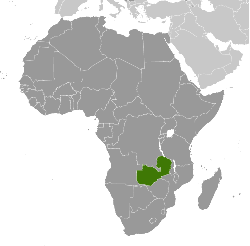
Zambia is a
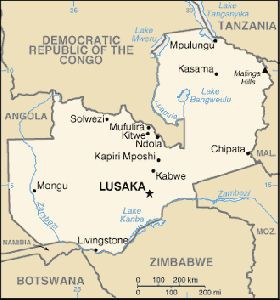
landlockeda term used to refer to a region, especially a country, that does not border the sea country in Southern Africa. The neighbouring countries are the Democratic Republic of the Congo to the north, Tanzania to the north-east, Malawi to the east, Mozambique, Zimbabwe, Botswana and Namibia to the south, and Angola to the west.
The capital city of Zambia is Lusaka. It is located in the south-central part of the country. Lusaka is also the largest city of the country with a population of 1,460,566. Other large cities are Ndola, Kitwe and Kabwe.
Society and culture
The culture of Zambia is mainly
indigenousnative to a region Bantu culture mixed with European influences.
Population
Zambia is a most highly
urbanisedpertaining to city life country. Its population is mainly concentrated around Lusaka in the south and the Copperbelt to the northwest.
Unemploymentthe phenomenon of joblessness in an economy in these urban areas is a serious problem. Most rural Zambians however are farmers. The population comprises approximately 72 ethnic groups, most of which are Bantu-speaking. Almost 90% of Zambians belong to the nine main ethnic groups: the Nyanja-Chewa, Bemba, Tonga, Tumbuka, Lunda, Luvale, Kaonde, Nkoya and Lozi.
Languages
The official language of Zambia is English. It is used to
conductto lead; to manage official business and is the medium of instruction in schools. The main local language, especially in Lusaka, is Nyanja. However, Bemba and Nyanja are spoken in the urban areas in addition to many other indigenous languages. All in all, there are up to 72 different languages spoken in Zambia.
Religion
According to the 1996 constitution, Zambia is officially a Christian nation. Still, a wide variety of religious traditions exist in the country. Approximately 5% of the population are Muslims with most living in urban areas. There is also a small Jewish community.
Government and politics
Zambian politics take place in a framework of a presidential representative democratic republic. The President of Zambia is both head of state and head of government in a multi-party system. The government exercises
executivebeing responsible for enforcing laws and judicial decisions, and for the day-to-day running of the state power, while
legislativebeing responsible for making laws power is
vestedsettled; fixed in both the government and parliament.
Economy
About 68% of Zambians live below the recognised national
poverty linethe threshold of poverty, below which one's income does not cover necessities. The country is among the world's poorest nations. Corruption is widespread. The Zambian economy has historically been based on the copper mining industry. The government now tries to promote agriculture, tourism, gemstone mining and hydro-power. In 2003, exports of nonmetals increased by 25% and accounted for 38% of all export earnings.